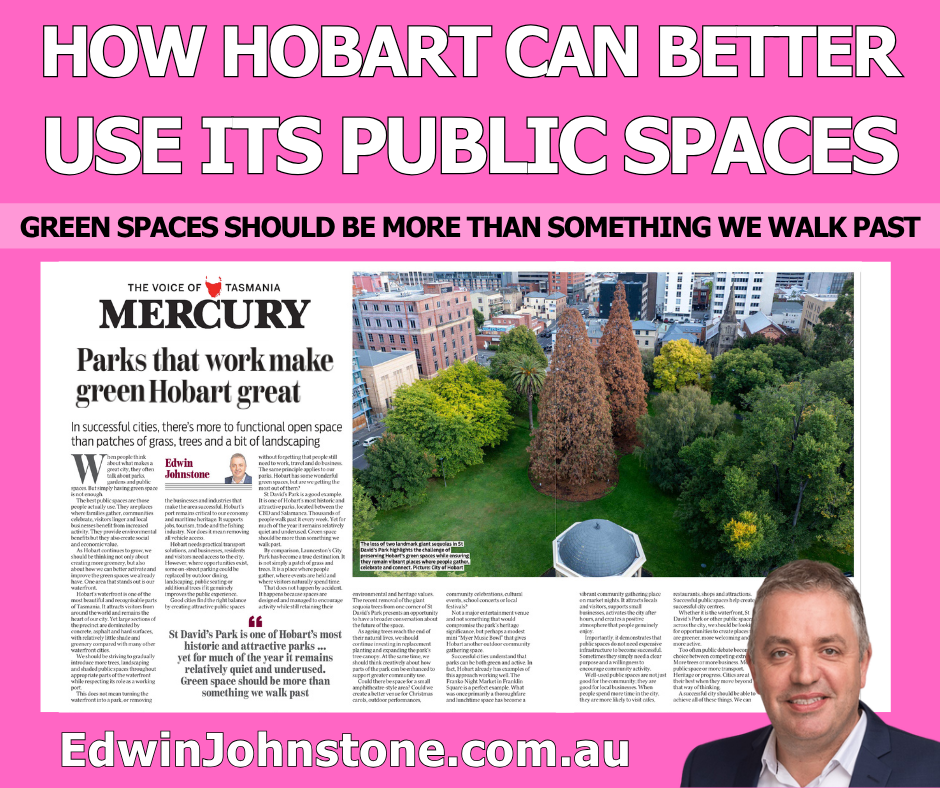
Published Mercury Newspaper
Green spaces should be more than something we walk past writes Edwin Johnstone.
When people think about what makes a great city, they often talk about parks, gardens and public spaces. But simply having green space isn’t enough.
The best public spaces are the ones people actually use. They are places where families gather, communities celebrate, visitors linger and local businesses benefit from increased activity. They provide environmental benefits, but they also create social and economic value.
As Hobart continues to grow, we should be thinking not only about creating more greenery, but also about how we can better activate and improve the green spaces we already have. One area that stands out is our waterfront.
Hobart’s waterfront is one of the most beautiful and recognisable parts of Tasmania. It attracts visitors from around the world and remains the heart of our city. Yet large sections of the precinct are dominated by concrete, asphalt and hard surfaces, with relatively little shade and greenery compared to many other waterfront cities.
We should be striving to gradually introduce more trees, landscaping and shaded public spaces throughout appropriate parts of the waterfront while respecting its role as a working port.
This does not mean turning the waterfront into a park or removing the businesses and industries that make the area successful. Hobart’s port remains critical to our economy and maritime heritage. It supports jobs, tourism, trade and the fishing industry. Nor does it mean removing all vehicle access.
Hobart needs practical transport solutions, and businesses, residents and visitors need access to the city. However, where opportunities exist, some on-street parking could be replaced by outdoor dining, landscaping, public seating or additional trees if it genuinely improves the public experience.
Good cities find the right balance by creating attractive public spaces without forgetting that people still need to work, travel and do business. The same principle applies to our parks. Hobart has some wonderful green spaces, but are we getting the most out of them?
St David’s Park is a good example. It is one of Hobart’s most historic and attractive parks, located between the CBD and Salamanca. Thousands of people walk past it every week. Yet for much of the year it remains relatively quiet and under-utilised. Green spaces should be more than something we walk past
By comparison, Launceston’s City Park has become a true destination. It is not simply a patch of grass and trees. It is a place where people gather, where events are held and where visitors naturally spend time.
That doesn’t happen by accident. It happens because spaces are designed and managed to encourage activity while still retaining their environmental and heritage values.
The recent removal of the giant sequoia trees from one corner of St David’s Park presents an opportunity to have a broader conversation about the future of the space. As ageing trees reach the end of their natural life, we should continue investing in replacement planting and expanding the park’s tree canopy. At the same time, we should think creatively about how parts of the park can be enhanced to support greater community use.
Could there be space for a small amphitheatre-style area? Could we create a better venue for Christmas carols, outdoor performances, community celebrations, cultural events, school concerts or local festivals?
Not a major entertainment venue and not something that would compromise the park’s heritage significance, but perhaps a modest mini “Myer Music Bowl” that gives Hobart another outdoor community gathering space.
Successful cities understand that parks can be both green and active. In fact, Hobart already has examples of this approach working well. The Franko Night Market in Franklin Square is a perfect example. What was once primarily a thoroughfare and lunchtime space has become a vibrant community gathering place on market nights. It attracts locals and visitors, supports small businesses, activates the city after hours and creates a positive atmosphere that people genuinely enjoy.
Importantly, it demonstrates that public spaces do not need expensive infrastructure to become successful. Sometimes they simply need a clear purpose and a willingness to encourage community activity.
Well-used public spaces are not just good for the community; they are good for local businesses. When people spend more time in the city, they are more likely to visit cafés, restaurants, shops and attractions. Successful public spaces help create successful city centres.
Whether it is the waterfront, St David’s Park or other public spaces across the city, we should be looking for opportunities to create places that are greener, more welcoming and more active.
Too often public debate becomes a choice between competing extremes. More trees or more business. More public space or more transport. Heritage or progress. Cities are at their best when they move beyond that way of thinking.
A successful city should be able to achieve all of these things. We can have a greener waterfront while maintaining a working port. We can support outdoor dining while maintaining practical access to the city. We can protect heritage while creating new opportunities for community events. And we can invest in parks that are not only beautiful to look at, but also become places where people gather, celebrate and connect.
As Hobart grows, we should focus not only on creating more green space, but on making sure our existing green spaces are places people actually want to spend time in.
Edwin Johnstone
Chair, Business Greater Hobart