
Published Mercury Newspaper
Adaptive Reuse Key to Faster CBD Housing, wtites Edwin Johnstone
Hobart’s former Tasmania Police headquarters on Liverpool Street could soon be transformed into 17 apartments and a ground-floor cafe under a $5 million proposal now before Hobart City Council.
This project represents exactly the sort of practical city building Hobart needs more of. Rather than allowing it to sit underutilised for years, the proposal focuses on adaptive reuse, taking an existing structure and giving it a new life.
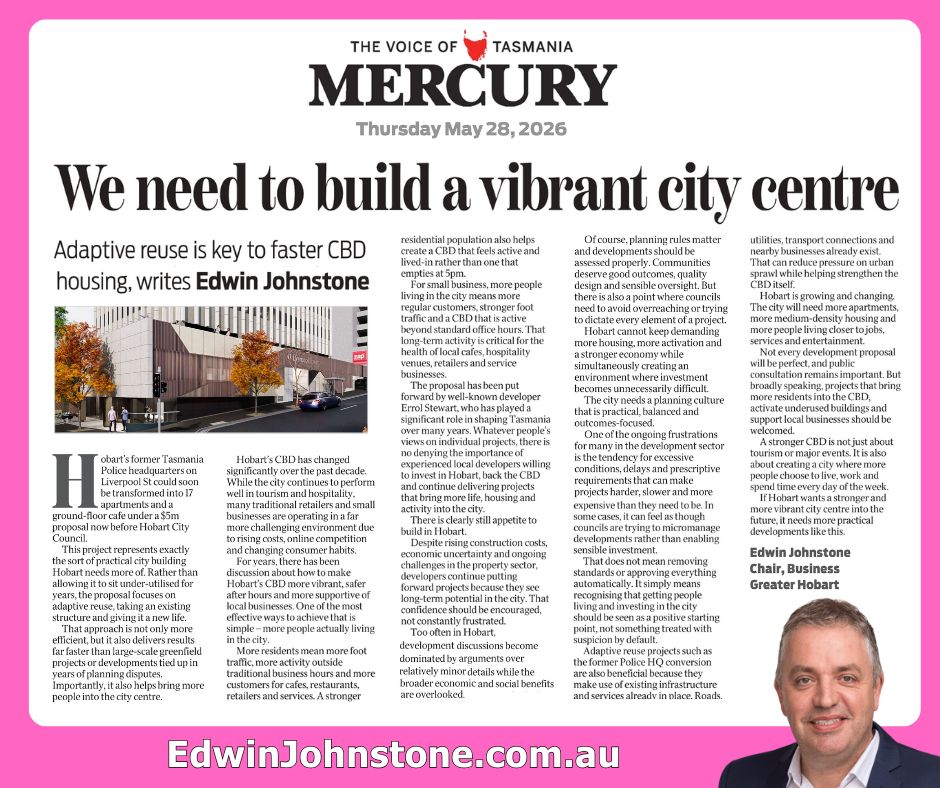
That approach is not only more efficient, but it also delivers results far faster than large-scale greenfield projects or developments tied up in years of planning disputes. Importantly, it also helps bring more people into the city centre.
Hobart’s CBD has changed significantly over the past decade. While the city continues to perform well in tourism and hospitality, many traditional retailers and small businesses are operating in a far more challenging environment due to rising costs, online competition and changing consumer habits.
For years, there has been discussion about how to make Hobart’s CBD more vibrant, safer after hours and more supportive of local businesses. One of the most effective ways to achieve that is simple: more people actually living in the city.
More residents mean more foot traffic, more activity outside traditional business hours and more customers for cafés, restaurants, retailers and services. A stronger residential population also helps create a CBD that feels active and lived-in rather than one that empties at 5pm.
For small business, more people living in the city means more regular customers, stronger foot traffic and a CBD that is active beyond standard office hours. That long-term activity is critical for the health of local cafés, hospitality venues, retailers and service businesses.
The proposal has been put forward by well-known developer Errol Stewart, who has played a significant role in shaping Tasmania over many years. Whatever people’s views on individual projects, there is no denying the importance of experienced local developers willing to invest in Hobart, back the CBD and continue delivering projects that bring more life, housing and activity into the city. There is clearly still appetite to build in Hobart.
Despite rising construction costs, economic uncertainty and ongoing challenges in the property sector, developers continue putting forward projects because they see long-term potential in the city. That confidence should be encouraged, not constantly frustrated.
Too often in Hobart, development discussions become dominated by arguments over relatively minor details while the broader economic and social benefits are overlooked.
Of course, planning rules matter and developments should be assessed properly. Communities deserve good outcomes, quality design and sensible oversight. But there is also a point where councils need to avoid overreaching or trying to dictate every element of a project.
Hobart cannot keep demanding more housing, more activation and a stronger economy while simultaneously creating an environment where investment becomes unnecessarily difficult. The city needs a planning culture that is practical, balanced and outcomes focused.
One of the ongoing frustrations for many in the development sector is the tendency for excessive conditions, delays and prescriptive requirements that can make projects harder, slower and more expensive than they need to be. In some cases, it can feel as though councils are trying to micromanage developments rather than enabling sensible investment.
That does not mean removing standards or approving everything automatically. It simply means recognising that getting people living and investing in the city should be seen as a positive starting point, not something treated with suspicion by default.
Adaptive reuse projects such as the former Police HQ conversion are also beneficial because they make use of existing infrastructure and services already in place. Roads, utilities, transport connections and nearby businesses already exist. That can reduce pressure on urban sprawl while helping strengthen the CBD itself.
Hobart is growing and changing. The city will need more apartments, more medium-density housing and more people living closer to jobs, services and entertainment.
Not every development proposal will be perfect, and public consultation remains important. But broadly speaking, projects that bring more residents into the CBD, activate underused buildings and support local businesses should be welcomed. A stronger CBD is not just about tourism or major events. It is also about creating a city where more people choose to live, work and spend time every day of the week.
If Hobart wants a stronger and more vibrant city centre into the future, it needs more practical developments like this.
Edwin Johnstone
Chair, Business Greater Hobart