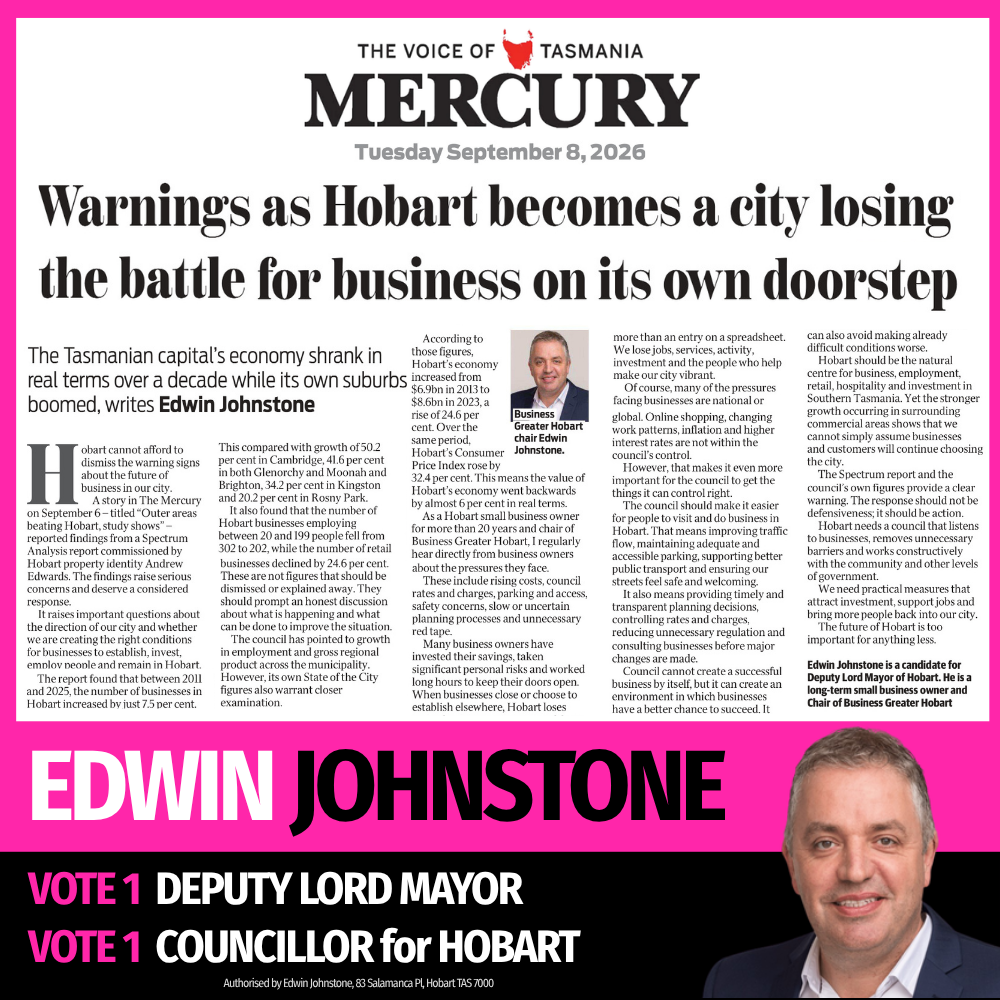
WARNINGS AS HOBART BECOMES A CITY LOSING THE BATTLE FOR BUSINESS ON ITS OWN DOORSTEP
THE TASMANIAN CAPITAL’S ECONOMY SHRANK IN REAL TERMS OVER A DECADE WHILE ITS OWN SUBURBS
BOOMED, WRITES EDWIN JOHNSTONE
Hobart cannot afford to dismiss the warning signs about the future of business in our city.
A story in The Mercury on September 6 – titled “Outer areas beating Hobart, study shows” – reported findings from a Spectrum Analysis report commissioned by Hobart property identity Andrew Edwards. The findings raise serious concerns and deserve a considered response.
It raises important questions about the direction of our city and whether we are creating the right conditions for businesses to establish, invest, employ people and remain in Hobart.
The report found that between 2011 and 2025, the number of businesses in Hobart increased by just 7.5 per cent. This compared with growth of 50.2 per cent in Cambridge, 41.6 per cent in both Glenorchy and Moonah and Brighton, 34.2
per cent in Kingston and 20.2 per cent in Rosny Park.
It also found that the number of Hobart businesses employing between 20 and 199 people fell from 302 to 202, while the number of retail businesses declined by 24.6 per cent. These are not figures that should be dismissed or explained away. They should prompt an honest discussion about what is happening and what can be done to improve
the situation.
The council has pointed to growth in employment and gross regional product across the municipality. However, its own State of the City figures also warrant closer examination. According to those figures, Hobart’s economy increased from $6.9bn in 2013 to $8.6bn in 2023, a rise of 24.6 per cent. Over the same period, Hobart’s Consumer Price Index rose by 32.4 per cent. This means the value of Hobart’s economy went backwards by almost 6 per cent in real terms.
As a Hobart small business owner for more than 20 years and chair of Business Greater Hobart, I regularly hear directly from business owners about the pressures they face. These include rising costs, council rates and charges, parking
and access, safety concerns, slow or uncertain planning processes and unnecessary red tape.
Many business owners have invested their savings, taken significant personal risks and worked long hours to keep their doors open. When businesses close or choose to establish elsewhere, Hobart loses more than an entry on a
spreadsheet. We lose jobs, services, activity, investment and the people who help make our city vibrant.
Of course, many of the pressures facing businesses are national or global. Online shopping, changing work patterns, inflation and higher interest rates are not within the council’s control.
However, that makes it even more important for the council to get the things it can control right.
The council should make it easier for people to visit and do business in Hobart. That means improving traffic flow, maintaining adequate and accessible parking, supporting better public transport and ensuring our streets feel safe and
welcoming.
It also means providing timely and transparent planning decisions, controlling rates and charges, reducing unnecessary regulation and consulting businesses before major changes are made.
Council cannot create a successful business by itself, but it can create an environment in which businesses have a better chance to succeed. It can also avoid making already difficult conditions worse.
Hobart should be the natural centre for business, employment, retail, hospitality and investment in Southern Tasmania. Yet the stronger growth occurring in surrounding commercial areas shows that we cannot simply assume businesses and customers will continue choosing the city.
The Spectrum report and the council’s own figures provide a clear warning. The response should not be defensiveness; it should be action.
Hobart needs a council that listens to businesses, removes unnecessary barriers and works constructively with the community and other levels of government.
We need practical measures that attract investment, support jobs and bring more people back into our city.
The future of Hobart is too important for anything less.
Edwin Johnstone is a candidate for Deputy Lord Mayor of Hobart. He is a long-term small business owner and Chair of Business Greater Hobart