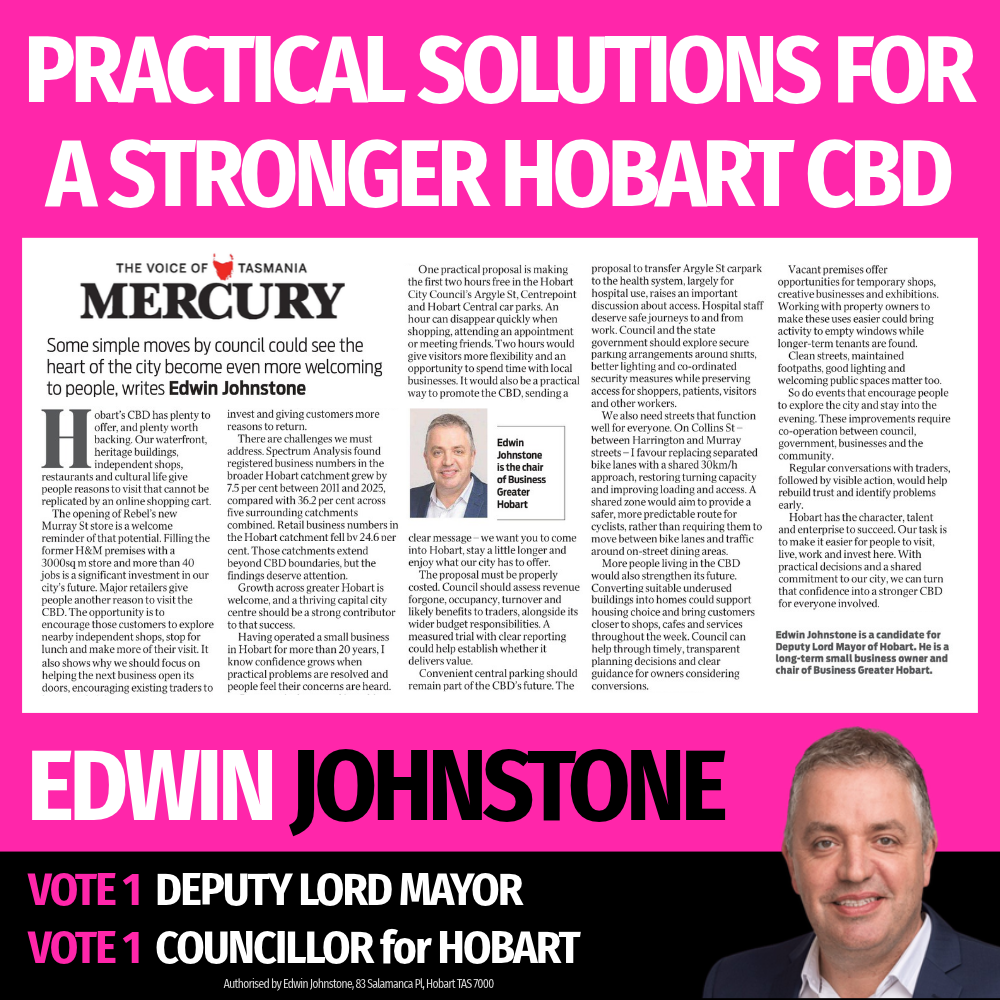
Published Mercury Newspaper
Hobart’s CBD has plenty to offer, and plenty worth backing. Our waterfront, heritage buildings, independent shops, restaurants and cultural life give people reasons to visit that cannot be replicated by an online shopping cart.
The opening of Rebel’s new Murray Street store is a welcome reminder of that potential. Filling the former H&M premises with a 3,000 square metre store and more than 40 jobs is a significant investment in our city’s future.
Major retailers give people another reason to visit the CBD. The opportunity is to encourage those customers to explore nearby independent shops, stop for lunch and make more of their visit.
It also shows why we should focus on helping the next business open its doors, encouraging existing traders to invest and giving customers more reasons to return.
There are challenges we must address. Spectrum Analysis found registered business numbers in the broader Hobart catchment grew by 7.5 per cent between 2011 and 2025, compared with 36.2 per cent across five surrounding catchments combined. Retail business numbers in the Hobart catchment fell by 24.6 per cent.
Those catchments extend beyond CBD boundaries, but the findings deserve attention. Growth across Greater Hobart is welcome, and a thriving capital city centre should be a strong contributor to that success.
Having operated a small business in Hobart for more than 20 years, I know confidence grows when practical problems are resolved and people feel their concerns are heard.
One practical proposal is making the first two hours free in Council’s Argyle Street, Centrepoint and Hobart Central car parks.
An hour can disappear quickly when shopping, attending an appointment or meeting friends. Two hours would give visitors more flexibility and an opportunity to spend time with local businesses.
It would also be a practical way to promote the CBD, sending a clear message: we want you to come into Hobart, stay a little longer and enjoy what our city has to offer.
The proposal must be properly costed. Council should assess revenue forgone, occupancy, turnover and likely benefits to traders, alongside its wider budget responsibilities. A measured trial with clear reporting could help establish whether it delivers value.
Convenient central parking should remain part of the CBD’s future. The proposal to transfer Argyle Street carpark to the health system, largely for hospital use, raises an important discussion about access.
Hospital staff deserve safe journeys to and from work. Council and the State Government should explore secure parking arrangements around shifts, better lighting and coordinated security measures while preserving access for shoppers, patients, visitors and other workers.
We also need streets that function well for everyone. On Collins Street between Harrington and Murray streets I favour replacing separated bike lanes with a shared 30 km/h approach, restoring turning capacity and improving loading and access.
A shared zone would aim to provide a safer, more predictable route for cyclists, rather than requiring them to move between bike lanes and traffic around on-street dining areas.
More people living in the CBD would also strengthen its future. Converting suitable underused buildings into homes could support housing choice and bring customers closer to shops, cafes and services throughout the week.
Council can help through timely, transparent planning decisions and clear guidance for owners considering conversions.
Vacant premises offer opportunities for temporary shops, creative businesses and exhibitions. Working with property owners to make these uses easier could bring activity to empty windows while longer term tenants are found.
Clean streets, maintained footpaths, good lighting and welcoming public spaces matter too. So do events that encourage people to explore the city and stay into the evening.
These improvements require cooperation between Council, government, businesses and the community. Regular conversations with traders, followed by visible action, would help rebuild trust and identify problems early.
Hobart has the character, talent and enterprise to succeed. Our task is to make it easier for people to visit, live, work and invest here.
With practical decisions and a shared commitment to our city, we can turn that confidence into a stronger CBD for everyone involved.
Edwin Johnstone is a candidate for Deputy Lord Mayor of Hobart. He is a long-term small business owner and Chair of Business Greater Hobart.