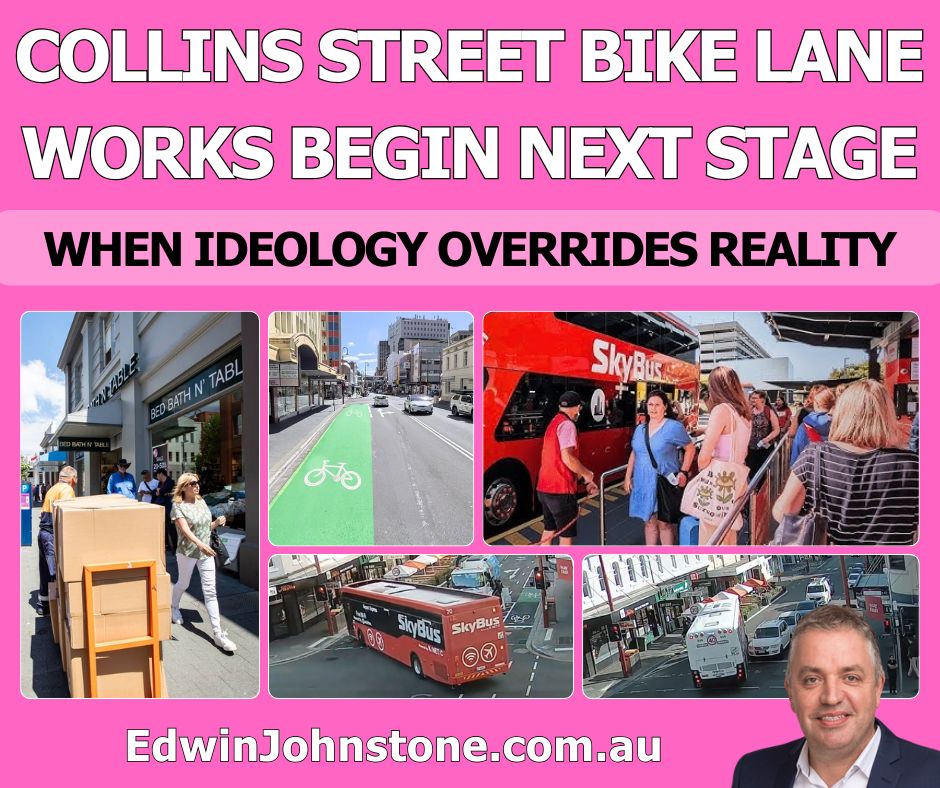
The latest stage of the Collins Street bike lane works again raises an important question: who exactly is this street being designed for?
Buses servicing CBD hotels will be forced to unload guests with luggage while stopped in the middle of the road.
Collins Street is not just a commuter corridor. It is a working city street. It services hotels, medical practices, small businesses, delivery vehicles and transport providers. These uses are not optional extras — they are part of what makes a CBD function.
When changes make it harder for these everyday activities to operate smoothly, it is reasonable to ask whether the balance is right.
A practical solution worth considering would be treating the section of Collins Street between Harrington and Murray Streets as a shared zone.
With a 30km/h speed limit set to come into place, a shared zone between Harrington and Murray Streets would make more sense than the current design, particularly given the addition of outdoor dining means cyclists must already move between the bike lane and traffic lanes.
Shared zones are specifically designed to accommodate multiple users in constrained urban environments. They recognise that in some locations, separation of every transport mode is simply not realistic without creating unintended consequences elsewhere.
What we are seeing on Collins Street is a classic example of what happens when planning theory meets operational reality.
Consultation on projects like this is important, but consultation only works if practical concerns raised by businesses, transport providers and street users are genuinely considered as part of the final design process.
The decision to reduce Victoria Street to a single exit lane has now been reversed. Yet this exact outcome was foreshadowed during consultation and identified in independent traffic analysis. These concerns were raised early, but they were not acted on.
Good planning should identify and resolve predictable operational issues before they occur, not after problems emerge.
Hobart deserves practical outcomes, not planning ideology.
Edwin Johnstone
Chair, Business Greater Hobart